
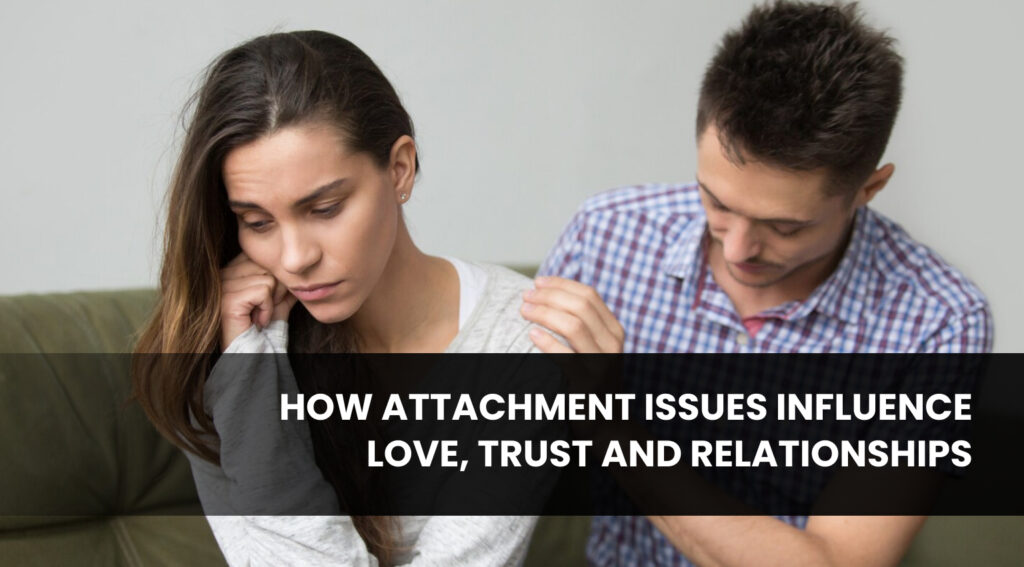
Relationships can feel confusing when your reactions don’t always match your intentions. You may want closeness but feel the urge to pull away. Or you may crave reassurance even when your partner shows they care.
Often, these patterns are connected to attachment issues, the emotional habits we develop early in life that shape how we connect with others.
Understanding these patterns is not about blaming yourself or your past. It’s about recognizing why certain feelings show up in relationships and learning how to build healthier connections.
Attachment issues refer to emotional patterns that influence how safe, secure, or anxious we feel in relationships. These patterns usually begin in childhood based on how our emotional needs were met.
For example, if someone grew up in an environment where love felt unpredictable, they may develop fears of abandonment or difficulty trusting others later in life.
These patterns often continue into adulthood unless we consciously work to understand and change them.

Attachment issues don’t always look dramatic. Often, they appear in small everyday behaviors that slowly affect trust and connection.
Situation | How Attachment Issues May Appear |
Your partner doesn’t reply quickly | You assume they are losing interest |
A disagreement happens | You fear the relationship may end |
Someone gets emotionally close | You feel uncomfortable and withdraw |
Your partner needs space | You feel rejected or anxious |
A relationship becomes serious | You start doubting the relationship |
These reactions are not signs of weakness. They are learned emotional responses that can be changed with awareness and support.
Psychologists generally identify several attachment styles that influence relationships.
Attachment Style | Typical Behavior in Relationships |
Secure Attachment | Comfortable with closeness and independence |
Anxious Attachment | Fear of abandonment and constant reassurance-seeking |
Avoidant Attachment | Difficulty with emotional closeness |
Fearful-Avoidant | Desire for connection but fear of getting hurt |
Many people recognize parts of themselves in more than one pattern. What matters most is becoming aware of how these patterns influence your relationships.
Sometimes people assume relationship problems are caused only by compatibility. But attachment patterns often play a deeper role.
You may notice signs like:
According to the therapist, these patterns can create cycles of misunderstanding, even when both partners care deeply about each other.
Of course, love requires emotional safety. When attachment wounds exist, the brain often goes into self-protection mode.
For example:
Over time, these reactions can create tension, even when both people want the relationship to work.
Understanding this dynamic can shift the focus from “What’s wrong with us?” to “What patterns are we repeating?”

The good news is that attachment patterns can change. Emotional habits are learned and they can also be relearned.
Here are some practical steps that help many people improve their relationships.
Start paying attention to moments when your emotions feel stronger than the situation.
Ask yourself:
Awareness is the first step toward change.
Many relationship conflicts happen because people expect their partner to guess their feelings.
Instead of saying:
“You never care about me.”
Try saying:
“When I don’t hear from you, I sometimes feel anxious. Reassurance helps me feel secure.”
At Restore Counseling Therapist, clear communication reduces misunderstandings.
Attachment issues often create automatic thoughts like:
It is important to pause and ask whether these thoughts are facts or fears.
Healthy relationships grow through consistent small moments:
Trust doesn’t appear overnight it grows through repeated experiences.
Sometimes attachment patterns are deeply rooted and difficult to change alone.
Working with a therapist can help you:
At Restore Counseling Therapist, therapy focuses on helping individuals recognize these patterns and build more secure, fulfilling relationships.
Therapy creates a safe environment where people can explore their emotional patterns without judgment.
At Restore Counseling Therapist, therapists work with clients to:
Therapy Focus | How It Helps |
Understanding past attachment patterns | Identifies the root of emotional reactions |
Emotional awareness | Helps recognize triggers and responses |
Relationship communication skills | Improves connection and reduces conflict |
Building self-trust | Encourages healthier emotional boundaries |
This process helps people feel more confident and secure in relationships.
Attachment issues don’t define your ability to love or be loved. They simply reflect emotional experiences that shaped how you learned to connect.
With awareness, communication, and the right support, people can develop healthier relationship patterns and experience deeper emotional security.
Many individuals who seek help from Restore Counseling Therapist discover that understanding their attachment style becomes the first step toward stronger, more fulfilling relationships.
Attachment issues often develop in childhood when emotional needs are inconsistently met. However, they can also form after painful experiences such as betrayal, neglect, or difficult relationships.
Yes. With self-awareness, healthy relationship experiences, and sometimes therapy, people can develop more secure attachment patterns over time.
They can create fears of abandonment, difficulty trusting partners, emotional withdrawal, or the need for constant reassurance, which may lead to misunderstandings.
If you frequently feel anxious, avoid emotional closeness, struggle with trust, or repeat similar relationship conflicts, attachment patterns may be influencing your relationships.
Yes. Therapy helps people understand their emotional patterns, process past experiences, and develop healthier ways to connect with others. Professionals at Restore Counseling Therapist support individuals in building stronger and more secure relationships.
Restore Counseling Therapist provides a safe space for you to explore your mental health journey.